
ENVRI CATALOGUE OF SERVICES:
Enabling Interoperability
Across Europe’s Environmental
Research Infrastructures
ENVRI-Hub Services Involved
Main Partners Involved

Stakeholder Groups
-
- Research Infrastructures and the wider scientific community
- EOSC and related initiatives
- Environmental and biodiversity data users
- Civil society, NGOs and citizen science initiatives
- Industry and private sector actors
User Types
-
- Researcher
- Professor
- Data Scientist
- Lab Manager
- Industry Researcher
- Policymaker
Purpose
Fragmentation across research infrastructures, heterogeneous service descriptions, and limited mechanisms for discovering and accessing digital scientific services remain major barriers to interoperability and effective reuse of environmental data in Europe. Addressing these challenges is central to ENVRI’s core mission of fostering integration and collaboration among European Environmental Research Infrastructures.
The Catalogue of Services (CoS) addresses these issues by providing a unified and standardised entry point to RI services, described using shared semantic profiles such as DCAT‑AP and I-Adopt. By making services discoverable, machine‑actionable through APIs, and directly integrable into analytical workflows, the CoS supports an open, interoperable and FAIR digital ecosystem for environmental research across Europe.
EPOS, the European Plate Observing System, operates a federated and sustainable research platform to provide coordinated access to harmonised and quality-controlled data from diverse Earth science disciplines, together with tools for their use in analysis and modelling.
EPOS is part of the ENVRI Community and, through its projects (ENVRI Plus, ENVRI FAIR and now ENVRI-Hub NEXT), it offers tools and expertise to other disciplines in Environmental science to lower the barriers to open, multidisciplinary and transnational science. The CoS of the ENVRI-Hub is the result of this collaboration, and it will be one of the building blocks of the forthcoming contribution to the EOSC Federation.
Task
The ENVRI-Hub NEXT project aims to overcome barriers in Environmental Science:
- A discovery barrier, where finding distributed data with diverse metadata is difficult, by harmonising descriptions to facilitate precise searching.
- The access barrier by unifying interfaces and protocols to enable seamless human and machine-to-machine interactions.
- The composition barrier by reducing the need for customised code to integrate diverse APIs, thereby enhancing workflow reusability.
- The processing barrier is mitigated by supporting automated workflows on remote infrastructures for Essential Climate Variable (ECV) analysis.
- The usability barrier by providing user-friendly tools that reduce steep learning curves for researchers.
The CoS is directly or indirectly involved in all those actions. It serves as a centralised, federated entryway for discovering and accessing data and services from Environmental Research Infrastructures (RIs), featuring a standardised and FAIR interface, while it provides a unified API interface for machine-to-machine interaction.
From a user’s perspective, the CoS facilitates data discovery via semantic search, data preview through map-based visualisations, and data analysis via an API gateway connected to the Analytical Framework. For RIs and service providers, it enhances visibility by showcasing assets and ensures interoperability through the adoption of the EPOS-DCAT-AP metadata standard. Ultimately, the CoS acts as a resource repository for harvesting and a bridge between scientists and the complex landscape of environmental data.
Challenge
Researchers usually face a fragmented landscape, where locating distributed environmental datasets requires immense manual effort. This is inefficient and frustrating. Scientists must navigate a series of protocols and distinct authentication systems for each Research Infrastructure, often necessitating multiple unique accounts. Instead of focusing on scientific inquiry, early-career researchers are forced to act as software engineers, writing non-reusable, ad hoc code to bridge heterogeneous interfaces and integrate disparate data streams. This technical complexity creates a steep learning curve, making the automation of complex workflows (like those required for Essential Climate Variables and multi-disciplinary studies in general) difficult to implement. Moreover, the absence of standardised metadata and provenance tracking hinders the reproducibility of experiments and creates significant friction in sharing interdisciplinary findings.
Solution
As the name suggests, the CoS is primarily a collection of (web) services to access data. Service providers use the EPOS-DCAT-AP metadata schema to describe their endpoints, and as a result, users can seamlessly query any services through a map-based user interface or a unified API layer.
Scientists can easily find the resources they need by using a free-text search, spatial bounding boxes, temporal ranges, or by filtering for specific Essential Climate Variables. The map-based interface renders service payloads, allowing immediate visual inspection of sample data and their geographic distribution. After that, it is possible to further refine the parameters of the selected services directly within the graphical interface, ensuring the retrieval of tailored datasets rather than bulk downloads.
To facilitate downstream analysis, the platform links directly to the Analytical Framework, exposing Jupyter notebooks as discoverable services that act as executable templates for data interaction. These notebooks guide researchers through complex workflows, demonstrating how to leverage specific APIs and I-ADOPT vocabularies to automate data processing and integration. The same APIs that feed the graphical interface can be used for machine-to-machine interaction; the Analytical Framework of the ENVRI-Hub offers a Python library that wraps the CoS APIs, and further simplifies workflows and computations.
Furthermore, the CoS is indexed by the Knowledge Base of ENVRI-Hub, so that its LLM model and its chatbot can help in the exploration of the available resources and the usage of the APIs.
Results
The 2026 release of the Hub includes many services and features, but others will come in the near future. The best way to explore the Catalogue of Services’ growing capabilities and the dataset provided by its services is by looking at the collection of Use Cases provided.
The CoS has a sharing feature that allows saving specific configurations of the platform. Scientists can exploit this feature to disseminate their findings. The EHN project partners used this capability to present interesting studies that highlight the datasets accessible and the tools available on the platform.
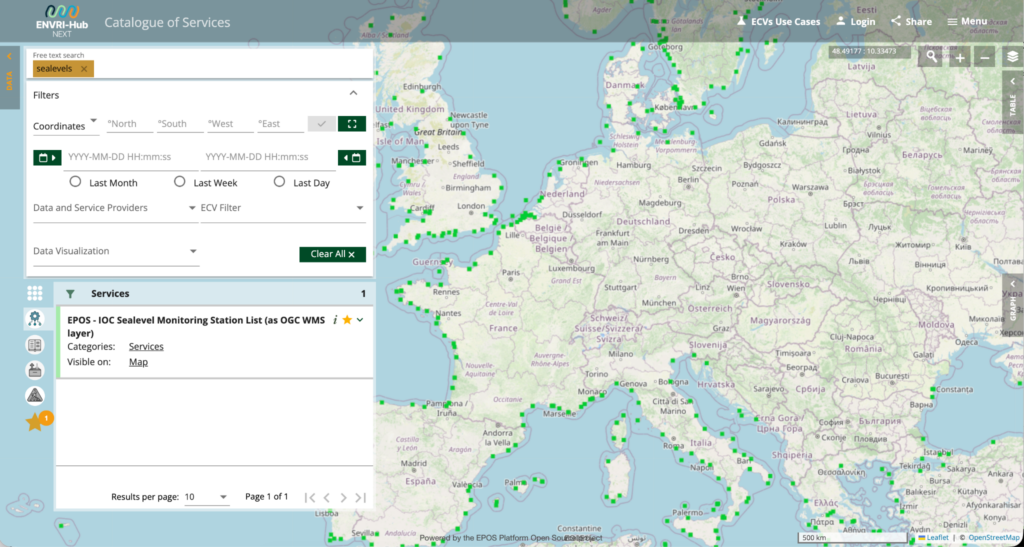
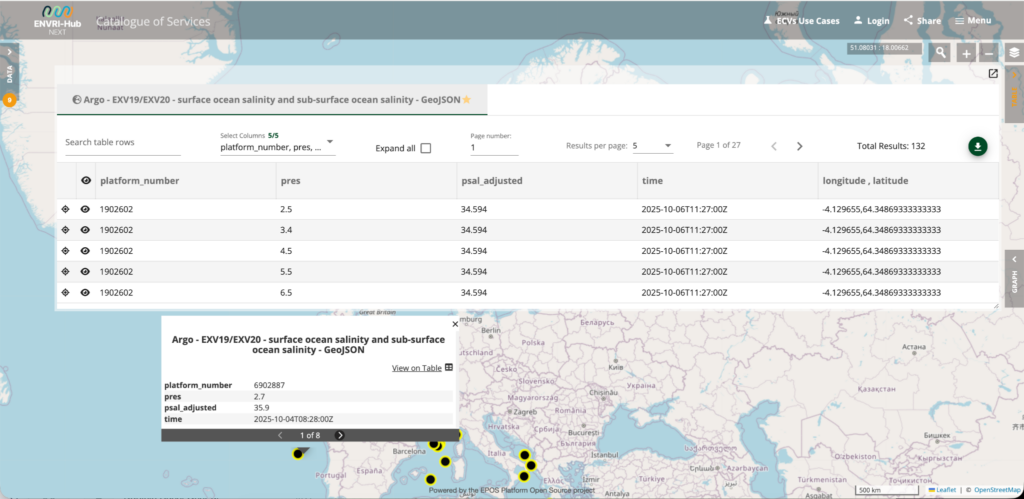
In the pictures, you can see a couple of them: the position of the sea-level monitoring stations around Europe, whose data can be accessed by clicking on them, and the surface ocean salinity and sub-surface ocean salinity, which exposes the position of the measurements and a downloadable and configurable table with related data.