EVERSE Community Engagement Event

Date: 5 February 2026
Location: CERN, Geneva, Switzerland

The EVERSE Network of Research Sofware Quality is a community community that will improve the quality of research software in Europe.

The EVERSE project created a set of guidelines and resources into the RSQkit (Research Software Quality Kit) and the Technology Radar to share existing best practices and ideas.

This event seeks to bring together EVERSE members with  RSEs and researchers who code, to share updates on EVERSE activities, foster knowledge-sharing and cross-domain collaboration, gather feedback and identify priorities.

Whether you are a researcher or RSE, whether you are involved in European Open Science clusters, or undertaking a similar role in academia, labs and industry, this is your chance to learn about these initiatives, and gives us your perspectives.

Thierry Carval (IFREMER & Euro-Argo ERIC) takes part in the session “Science Clusters: Cross-domain experiences and challenges” at 11:00 CET.

ENVRI-Hub NEXT at ISGC 2026

Date: 15-20 March 2026
Location: Taipei

The exponential growth of research data is reshaping the scientific landscape. What once came mainly from controlled experiments is now complemented by continuous streams from sensors, simulations, and digital interactions. A central focus is the need for trustworthy and sovereign data ecosystems that allow researchers to retain control over sensitive resources while enabling collaboration across disciplines and borders. At the same time, the rise of AI-driven discovery and decision-making places new demands on data quality: models require information that is not only accurate but also transparent in origin, rights, and conditions of use.

ISGC 2026 will focus on the theme “Trustworthy Infrastructures and AI for Global Open Science – Enabling Data Sovereignty and Secure Research Collaboration”, addressing pressing issues such as Artificial Intelligence (AI), Security, Data Sovereignty, Open Science, Research Infrastructures, Ethics of Computing, Societal Impacts, Misinformation and Disinformation, Sovereign Capabilities, Global Collaborations, and Science for a Sustainable Future. Bringing together leading experts from academia, research infrastructures, and industry, ISGC 2026 explores how emerging technologies—from AI and quantum-enhanced computing to big data analytics—can shape a trustworthy and sustainable future across disciplines.

The program spans 10 scientific topics: Physics & Engineering Applications, Health & Life Sciences, Earth & Environmental Sciences & Biodiversity, Social Sciences & Humanities, Virtual Research Environments, FAIR & Trusted Data, Networks & Security Infrastructures, Cloud & Virtualization, Converging High-Performance Computing, and Artificial Intelligence (AI). Through keynotes, workshops, international project reports, and peer-reviewed contributions, ISGC 2026 continues to strengthen global collaborations, cultivate future scientific leaders, and bridge cutting-edge technologies with societal responsibility.

ENVRI-Hub NEXT at ISGC 2026

Zhiming Zhao, University of Amsterdam and part of the ENVRI-Hub NEXT project, presents the poster “Enhancing Virtual Research Environments for Environmental Research Using Advanced AI” in the poster session.

ENVRI at EGU26

Discover the ENVRI contributions at the upcoming EGU26 in Vienna, submit your abstracts and join us there!

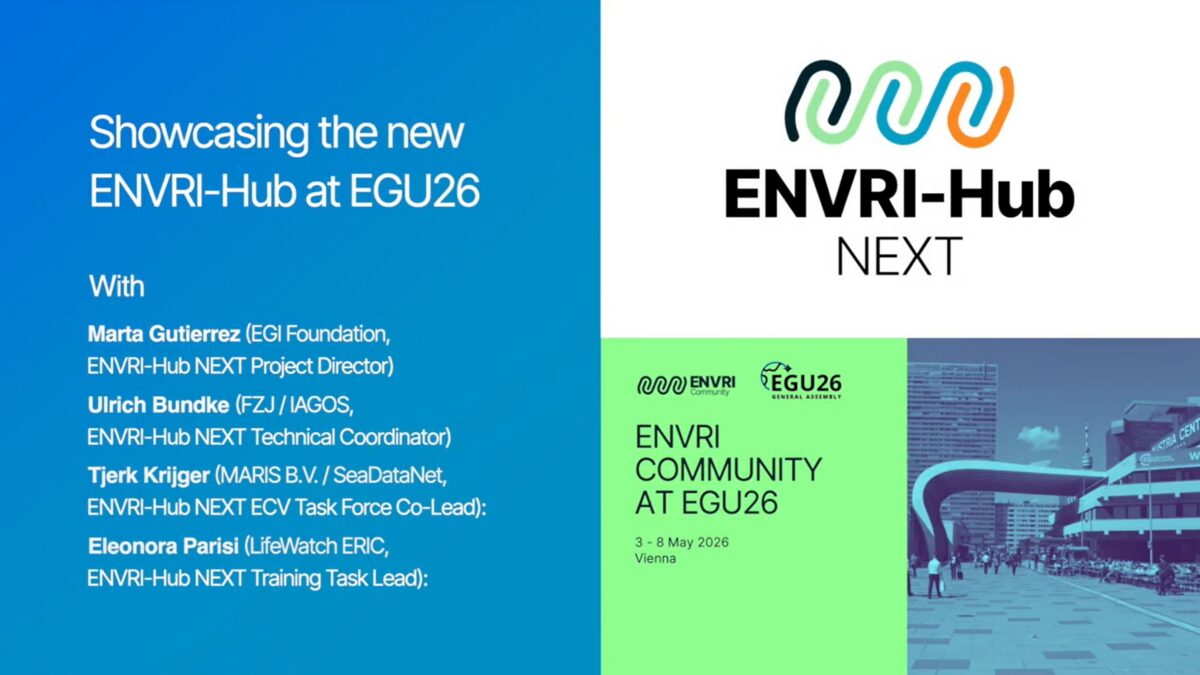
The ENVRI community is delighted to announce its participation in the European Geosciences Union (EGU) General Assembly 2026which will take place in Vienna from 3 to 8 May 2026.

The EGU General Assembly 2026 brings together geoscientists from all over the world to one meeting covering all disciplines of the Earth, planetary, and space sciences. The EGU aims to provide a forum where scientists, especially early-career researchers, can present their work and discuss their ideas with experts in all fields of geoscience.

Meet us at the ENVRI Community booth #27 of the EGU26 exhibition to learn about projects such as ENVRI-Hub NEXT, ENVRINNOV, and IRISCC.

This page is being constantly updated with content from other ENVRI-related projects and RIs.

Explore Relevant Sessions

The ENVRI community is excited to support and promote several key sessions that highlight the collaborative role of RIs in advancing environmental science:

ITS1.20/ESSI4.3 – Co-Creating Climate Services: Linking Essential Variables with Actionable Decision SupportESSENTIAL VARIABLES FOR GLOBAL COOPERATION AND INTEROPERABILITY

Convener: Anca Hienola Co-conveners: Tomohiro OdaTheresia BilolaFederico DragoMatti HeikkurinenGregor FeigHiroshi Suto

The paradigm of Essential Variables (EVs) – ECVs, EOVs, EBVs – provides a data-driven foundation for global environmental monitoring (GCOS, GEO, UN SDGs). Yet, their full potential is hampered by interoperability gaps, fragmented governance, and siloed infrastructures, limiting integrated use and translation into local action.

Conversely, local demand for actionable information is growing. Earth Observation data, often as Analysis-Ready Data (ARD), must be transformed into locally relevant, co-created Action-Ready Information (ARI) for climate solutions. This requires integrating global EVs with local data and knowledge.

This session bridges these fronts. We explore technical, infrastructural, and socio-technical advancements to evolve EVs into a truly interoperable, global common language and ensure their effective translation for local decision-making. We welcome contributions on:

– Interoperability Foundations: Semantic frameworks (iADOPT, SOSA/SSN), FAIR principles, and lessons from research infrastructures (ENVRI, CRDCs) aligning EVs across domains and global programmes.
– From ARD to ARI: Case studies on transforming EV-based products into local insights via co-creation, integrating satellite data with in-situ, citizen science, and indigenous knowledge.
– Cross-Scale Infrastructure: Architectures and platforms (e.g., digital twins) enabling seamless data flow from global systems to local applications.
– Policy & Capacity: How interoperable EVs strengthen global policy (IPCC, SDGs) and how local insights inform action, including funding, capacity building, and governance models.

We invite scientists, data engineers, social scientists, and policymakers to connect the “essential” with the “actionable”, forging a coherent path from global observation to local solution.

ESSI2.5 – BRIDGING EARTH SCIENCE RESEARCH THROUGH INTEGRATED E-INFRASTRUCTURES AND VIRTUAL RESEARCH ENVIRONMENTS (VRES): FROM DIGITAL SERVICES TO DIGITAL TWINS

Convener: Massimiliano Assante Co-conveners: Christian PagéMagdalena BrusLesley WybornChris AthertonJacco KonijnEugenio Trumpy

Scientific discovery today increasingly depends on the availability of digital services and infrastructures that span the entire research workflow. While sensors, simulations, and lab experiments produce massive data, many tools for analysis remain fragmented in stand-alone systems, often hindering collaboration and a comprehensive understanding of complex Earth systems.

To address this, e-Infrastructures and Virtual Research Environments (VREs) are revolutionising how research is conducted. By providing a cohesive ecosystem, these platforms allow researchers from diverse disciplines to manage the research lifecycle: from data acquisition and processing to modeling and dissemination in the spirit of Open Science. This integration enables the research community to transition from isolated tools to interoperable systems like Digital Twins.

This session aims to highlight how interoperable e-Infrastructure services can be used to build VREs and Virtual Labs to provide end-to-end support, strengthening research capacity through collaboration between service providers and scientists. We bring together case studies and new approaches from all domains of the Earth sciences, focusing on both technological implementations and scientific applications.

Contributions in this session will:
– Demonstrate practical examples of how digital services, VREs, and e-infrastructures enhance research workflows in Earth and environmental sciences.
– Present innovative approaches to integrating tools across domains and providers, including outcomes from collaborative projects, virtual laboratories, and digital twins.
– Highlight technical implementations, including research software applications, semantic approaches, modeling practices, and the management of large-scale data.
– Share lessons learned from user-driven design, community engagement, training and support strategies.
– Address challenges of interoperability and sustainability in distributed digital services, highlighting pathways to foster collaboration across infrastructures and research domains.

By bringing together service providers, research infrastructures, and end-users, this session will provide a unique overview of the digital landscape and its impact on science. It will foster dialogue on how different infrastructures can collaborate more effectively to provide integrated, sustainable solutions, embedding Open Science principles across the research lifecycle, and advance both science and society.

Solicited authors:
Tim Rawling

ESSI2.6 – Shaping the European landscape for Earth System Science – Making transnational data use of research infrastructures

Convener: Wolfgang zu Castell Co-conveners: Sebastien PayanJean-Philippe MaletSören Lorenz

Knowledge discovery in Earth System Science (ESS) relies on observational, experimental and simulation data being available for all compartments (atmosphere, land surfaces, ocean, solid Earth, biodiversity) of the Earth system. On top of that, leveraging the potential of large-scale AI tools and generative AI requires data to be interoperable in a machine-actionable, AI-ready way. Towards this goal, several research infrastructures are aggregating, structuring and distributing science data for researchers to be exploited and combined through a portfolio of services. Hereby, programs to foster these activities have been initiated by national as well as international initiatives, resulting in a colorful mix of domain-oriented, geographically-oriented, or target group-oriented research infrastructures.

Shaping the European Open Science Cloud (EOSC), all of them share the goal of offering seamless access to high-quality and reusable research data and services following the FAIR principles and Open Science paradigms. We aim to implement this goal as a network of actors on both the national as well as the international level, making best use of the given opportunities.

The aim of the session is to foster the ongoing discussion on how to jointly shape the European research infrastructure landscape for EES driven by high-level and cross-disciplines scientific use cases and best practice scenarios.

We welcome contributions:

  • showcasing successful examples of creating synergies among different research infrastructures,
  • demonstrating efforts in building new products based on integrating services from multiple providers,
  • identifying gaps by highlighting needs deriving from specific research questions,
  • presenting use cases which should be taken-up by joining forces among research infrastructures.
  • Representatives of some international research infrastructures will be invited to elaborate on these actions.

ITS1.19/AS4.8 – ADVANCING ENVIRONMENTAL SCIENCES WITH INNOVATION AND RESEARCH INFRASTRUCTURES

Convener: Jean Sciare Co-conveners: Janne-Markus RintalaMarina Papageorgiou

Environmental challenges such as climate change, biodiversity loss, water scarcity, and ocean degradation demand new ways of observing, monitoring, and understanding the Earth system. Research Infrastructures (RIs) in the ENVRI community—spanning atmospheric, marine, terrestrial, and solid earth sciences—provide the backbone of European environmental observation and long-term data stewardship. Yet, the growing complexity of environmental change requires innovative technologies and services to enhance monitoring, strengthen interoperability, and accelerate the translation of knowledge into actionable insights.

This session brings together researchers, technologists, and stakeholders to showcase advances illustrating (1) the role of emerging technologies and (2) service-oriented approaches in shaping the future of environmental monitoring.

Emerging technologies include advanced instrumentation, miniaturized and autonomous sensors for atmospheric, hydrological, soil, and marine processes, as well as unmanned aerial systems, drones, satellite constellations, and IoT networks that link in-situ with remote sensing. Artificial intelligence (AI) is transforming how environmental data are processed, harmonized, and applied in predictive modelling.

The ocean, a key climate regulator, remains critically under-observed for carbon fluxes, particularly beyond shipping routes. Addressing this gap, the GEORGE project—a collaboration between EMSO ERIC, EURO-ARGO ERIC, ICOS ERIC, research institutions, universities, and industry—develops novel tools and methods to measure carbonate chemistry (e.g., pH, alkalinity, dissolved inorganic carbon, pCO₂) across diverse marine environments.

Services are equally vital. Trans-National Access (TNA) schemes offered by ENVRIs provide opportunities for researchers to use state-of-the-art facilities, advanced instrumentation, and high-quality data services beyond national systems. These services foster collaboration, accelerate innovation, and support co-created solutions to pressing challenges. The convergence of cloud-based infrastructures, FAIR data principles, interoperability frameworks, and user-centered service design ensures that resources are not only technically robust but also widely accessible and impactful for science, policy, and society.

Short Courses

SC2.18 – HARNESSING THE ENVRI-HUB: DATA, TOOLS, AND SERVICES FOR INTERDISCIPLINARY RESEARCH

Co-organized by AS6/CL6/ERE5/GM11/NH15
Convener: Kety Giuliacci Co-conveners: Eleonora ParisiZhiming Zhao

Earth and environmental sciences thrive on data diversity: from ocean temperatures to biodiversity records, from climate indicators to geological observations. Yet, this very diversity can also be a barrier: different datasets are described with different standards, stored in different formats, and are difficult to connect across research infrastructures. The ENVRI-Hub provides a set of tools to overcome these challenges. It offers researchers a unified framework to discover, access, and reuse complex and multidisciplinary data.

This short course will give researchers a practical introduction to how ENVRI-Hub workflows can directly support their own projects, to build more reproducible and impactful science.

How You Can Participate

We invite all ENVRI RIs and supporting projects to:

  • Attend our sessions
  • Visit our ENVRI Community Booth #27
  • Join the ENVRI-Hub NEXT Short Course

We look forward to seeing you at EGU26, as we highlight the collective strength and impact of the ENVRI community in advancing environmental research!

Check out what we did in 2025!

Webinar: Key Exploitable Results Management

Key Exploitable Results Management

Turning Results into Impact: Master KERs Management and Reporting

The Key Exploitable Results (KERs) Management Webinar is a joint initiative by the IRISCCENVRINNOV, and ENVRI-Hub NEXT projects. The webinar will explore KERs and how they contribute to project impact and EC reporting. The session will provide awareness, alignment, and practical guidance on KERs, including value definition, ownership, reporting requirements, and strategies to enable uptake.

This webinar is designed to clarify responsibilities, de-risk IP/licensing, and harmonise KER reporting across projects.

Information

  • Date: 29 October 2025
  • Time: 11:00-12:00 CET
  • Trainer: Elia Bellussi, Senior Strategy and Innovation Officer at EGI Foundation
  • Watch the recording

Why Attend

Participants will learn to:

  • Understand what KERs are and why they matter for project impact.
  • Connect KERs to EC reporting and project KPIs, including TRL progression.

  • Clarify roles and responsibilities for KER management.
  • Standardise reporting to EC Funding & Tenders Portal.
  • Reduce risks and accelerate uptake, dissemination, and exploitation.

Who Should Participate

  • KER Champions, WP Leaders and Task Leads relevant for specific KER
  • Innovation Managers
  • IP Managers, Communications, and Exploitation Staff
  • Anyone interested in innovation, management of the project results and exploitation.

Agenda

  • 11:oo – Welcome & framing – Purpose, scope, and expected outcomes (awareness + alignment, not deep training)
  • 11:05 – Why KERs? – Value & needs → measurable impact, KPIs, TRL progression, Reviews & EC Portal compliance, de-risking IP/licensing, enabling uptake/pilots</strong”>
  • 11:25 – Roles & responsibilities (RACI-lite) – KER Champion, WP/Task Lead, Innovation Manager, IP Manager & Comms/Exploitation, quick RACI slide
  • 11:45 – Q&A

Towards an Integrated Future for Environmental Science: ENVRI-Hub NEXT Reaches 18-Month Milestone

The ENVRI-Hub NEXT project has completed its first 18 months, marking a significant milestone in the development of the next-generation open-access platform for Europe’s environmental research infrastructures (RIs). Since February 2024, the project has transitioned from planning to active implementation, laying a robust technical and collaborative foundation for a more integrated and powerful environmental science community.

“Reaching this 18-month milestone is a testament to the incredible collaboration across our consortium,” said Marta Gutierrez, EGI Foundation, ENVRI-Hub NEXT Project Director. “We have successfully established the foundations for an integrated and operational ENVRI-HUB offering the best of what environmental RIs and e-infrastructures have to offer together”

This milestone reflects the hard work of the entire consortium and the growing engagement of our community. Here’s a look at some of the key achievements.

Solid Technical Foundations: The Hub Takes Shape

A major focus of this period has been the agile development and integration of the core services that will form the operational ENVRI-Hub.

  • A Refreshed and Cohesive Gateway: Work is underway to harmonise the ENVRI-Hub central gateway. This update will better showcase the latest developments from individual components like the Catalogue of Services and Knowledge Base, providing the community with a simpler and more intuitive point of entry to the entire ENVRI-Hub ecosystem.
  • A Unified Entry Point for Data and Services: The Catalogue of Services (CoS) has been significantly expanded and enhanced. It now provides a centralised, FAIR-compliant gateway to discover and access data and services from across the ENVRI cluster. New features include an API library for developers and a user-friendly graphical interface, making it easier than ever to find the resources you need.
  • Smarter Discovery with AI: The ENVRI Knowledge Base has been upgraded with a new, modern architecture. It now indexes a vast amount of content from participating RIs and is pioneering the use of Large Language Models (LLMs) to power a dialogue-based search. This allows you to ask complex, natural language questions to find relevant research assets, publications, and datasets.
  • Streamlined Access to Essential Climate Variables (ECVs): A cornerstone of our mission is to facilitate research on climate change. We have developed a dedicated ECV-data-access Python library and integrated ECV-focused functionalities directly into the CoS. This enables researchers to quickly filter and access services and data related to specific Essential Climate Variables, streamlining the path from data discovery to analysis.
  • An Analytical Playground for Researchers: The project has deployed a containerised Analytical Framework, providing a flexible JupyterHub-based environment. This “Virtual Research Environment” (VRE) allows our developers and test users to compose and execute analytical workflows using data and services from multiple RIs seamlessly. The envrihub Python library is the central development, offering a unified, programmatic way to interact with the Hub’s resources directly from code.
  • In addition, we explored the technical feasibility of integrating the ENVRI-Hub and its components with the European Open Science Cloud (EOSC), and we are currently in talks with the EOSC Beyond project to take this task one step further.

A Growing and Engaged Community

Technology is only one part of the equation. A successful Hub is built with and for its users.

Launch of the ENVRI-Hub User Group: In February 2025, we officially launched the ENVRI-Hub User Group, which has already grown to include over 50 members from diverse backgrounds. This group is vital for the co-creation of the Hub, providing early feedback to ensure our development meets real-world needs. The first official online meeting was held on 25 September 2025.

A Cohesive ENVRI Identity and Presence: We have consolidated the ENVRI branding and given the ENVRI Community website a visual update, creating a central, recognisable home for all our activities. In collaboration with our sister project ENVRINNOV, we jointly manage communication channels. This includes the ENVRI newsletter and our social media presence, which has now moved its primary engagement to LinkedIn and Bluesky. Follow us on LinkedIn for the latest project updates, news, and opportunities to engage with the community.

A Strong Presence at Major Events: ENVRI-Hub NEXT helped coordinate the successful joint ENVRI Community booth and scientific sessions at the EGU General Assembly 2025 in Vienna, showcasing the power of our collaborative community to thousands of researchers. The booth featured representatives from a wide range of ENVRI-related projects.

We have also initiated our public training activities in May, with a joint webinar co-organised with the EOSC-EVERSE project on “Research Software Quality Assessment”, and expect to host more in the coming months.

The Road Ahead: From Staging to Production

The first 18 months have set the stage for an exciting future. Ulrich Bundke, FZJ, ENVRI-Hub NEXT Technical Coordinator, added: “The successful staging deployment proves our technical architecture is sound. In the next phase, we will focus on hardening this environment for production, adding more content and starting public operations.” 

As we move into the second half of the project, we will focus on refining these services based on your feedback, onboarding more data and services, and preparing for a wider public release.

This progress is a testament to the power of collaboration. We extend a huge thank you to all the project partners, RIs, and community members who have contributed to this journey.

Explore Further:

EOSC Symposium 2025

ENVRI-Hub NEXT will be featured at the EOSC Symposium 2025 in Brussels, as part of the Lightning Talks and Demos session on 4 November.

The EOSC Symposium 2025 marked the exciting transition of the EOSC Federation into its operational phase. As with previous editions, participants entertained insightful discussions, strategic updates, and unparalleled networking opportunities.

Organised by the EOSC Association, with the support of the EOSC Gravity and EOSC Focus projects, the EOSC Symposium 2025 took place on 03-05 November at the historic Le Plaza Hotel in Brussels.

The flagship event brought together the larger EOSC community of policy makers, funders, researchers, representatives of research-performing organisations, as well as national and pan-European data infrastructures, Research Infrastructures, and e-Infrastructures, all of whom are working together to build EOSC and the EOSC Federation.

ENVRI-Hub NEXT was represented by Nafis Tanveer Islam (University of Amsterdam) in the Lightning Calls and Demos session on 4 November 2025, 10:15-11:30 CET, with the demo “An intelligent system for discoverability and collaboration”, featuring the ENVRI Knowledge Base, currently being developed in ENVRI-Hub NEXT.

ENVRI-Hub NEXT at FBAS 2025

FBAS 2025 – 5th International Forum on Big Data for Sustainable Development Goals

6-8 September 2025 | Beijing, China

EGI Foundation Director Tiziana Ferrari joins the meeting with the presentation “European coordinated efforts for access and analysis of environmental data: the ENVRI-Hub NEXT approach” on 7 September. Check out the full programme here.

About

The year 2025 marks the 10th anniversary of the United Nations 2030 Agenda for Sustainable Development. Despite a decade of efforts, the world still faces numerous challenges on the path to achieving the Sustainable Development Goals (SDGs), necessitating deeper cooperation and innovative practices. Digital technologies, represented by Earth observation, big data, and artificial intelligence, are capable of bringing about innovative changes in multiple aspects of SDG monitoring and evaluation. They also drive the formulation and implementation of integrated solutions to sustainable development challenges across sectors and regions.

From 2021 to 2024, the Chinese Academy of Sciences successfully hosted four consecutive International Forums on Big Data for Sustainable Development Goals. The 5th International Forum on Big Data for Sustainable Development Goals will be held in Beijing from September 6th to 8th, 2025. This forum will bring together top scientists, policymakers, industry leaders, and practitioners from around the globe to explore how to innovatively leverage digital technologies to accelerate the achievement of the SDGs, injecting new momentum and wisdom into global sustainable development.

ENVRI at the RTI Summit 2025

The ENVRI community is participating in the RTI Summit 2025, a key event under the Danish EU Presidency. The summit will take place on 22-23 October 2025 in Copenhagen, Denmark.

About the RTI Summit 2025

The RTI Summit 2025 will convene European leaders to shape the future of Research and Technology Infrastructures (RTIs). The event will introduce the new European strategy for RTIs and facilitate discussions on critical areas such as emerging technologies, sustainable financing, and enhanced cross-sector collaboration. It represents a significant opportunity to contribute to a more integrated European innovation ecosystem.

ENVRI Participation: Joint Exhibition Booth

The ENVRI community will be featured at the summit’s exhibition. We invite attendees to visit our booth, which will be co-managed by the IRISCC and ENVRI-Hub NEXT projects.

This collaborative presence will highlight the role of Environmental Research Infrastructures in the European RTI landscape. Visiting the booth will offer the opportunity to:

  • Understand Synergies: Learn about the complementary objectives of the IRISCC project, focused on climate change impacts, and the ENVRI-Hub NEXT project, focused on technical integration and service provision.

  • Engage with Experts: Connect with representatives from the ENVRI community to discuss the capabilities and data services of our research infrastructures.

  • Explore Collaboration: Discover potential avenues for engagement with Europe’s environmental research infrastructures.

Summit Audience

The event will host a distinguished audience, including:

  • EU and national policymakers

  • Leadership and experts from Research and Technology Infrastructures

  • Representatives from industry, research organisations, universities, and funding agencies

Event Details

We look forward to productive discussions on strengthening the environmental science sector within Europe’s research infrastructure strategy.

  • Event: RTI Summit 2025

  • Date: 22-23 October 2025

  • Location: Scandic Copenhagen, Denmark

  • Find us at: The exhibition booth co-hosted by the IRISCC and ENVRI-Hub NEXT projects.

For further information and to register, please visit the official RTI Summit 2025 website.

ENVRI-Hub NEXT at IDW 2025

International Data Week 2025

Data for positive change: Empowering communities and advancing research

13-16 October 2025 – Brisbane, Australia

International Data Week 2025 (IDW 2025) is the premier global gathering for data scientists, researchers, policymakers, and industry leaders focused on harnessing data for positive societal change. Held in Brisbane, Australia, from October 13 to 16, 2025, the event features the Research Data Alliance (RDA) Plenary and SciDataCon, fostering collaboration and knowledge sharing to advance data-driven discovery and innovation for the benefit of society.

The International Data Week is a joint effort by:

    • The Committee on Data (CODATA) of the International Science Council
    • The World Data System (WDS)
    • The Research Data Alliance (RDA)

ENVRI-Hub NEXT at IDW 2025

Anca Hienola (FMI) represents ENVRI-Hub NEXT on 16 October at 11:00 AEST, during Session 10 Infrastructures to Support Data-Intensive Research – Local to Global, with the presentation “Breaking the Silos in Environmental Science One Infrastructure at a Time.”

ENVRI-Hub NEXT at EGI2025

At the annual EGI conference, international scientific communities, computing and service providers, European projects, security experts, community managers, and policymakers gather to advance research and innovation in data-intensive processing and analytics in a safe and open environment with room for in-depth discussion, new insights, networking, and a lot of fun!

EGI2025 takes place at the stunning Palacio de la Magdalena in Santander, Spain, from June 2nd to June 6th, 2025.

For this edition of the EGI annual conference, we are hosted by the Consejo Superior de Investigaciones Científicas (CSIC) and Laboratório de Instrumentação e Física Experimental de Partículas (LIP).

ENVRI-Hub NEXT at EGI2025

ENVRI-Hub NEXT takes part in the conference via several contributions:

“FAIR Interoperability in EOSC and Beyond: Climate Change Adaptation and Mitigation Approach” session
Tuesday 3 June, 14:00-17:00
Marta Gutierrez David, EGI Foundation – ENVRI-Hub NEXT

“The Invisible Infrastructure: IAM, Interoperability and the Architecture of Trust” session
Wednesday 4 June, 14:00-15:30
Ville Tenhunen, EGI Foundation – Seamless and secure access to research infrastructure data: AAI in ENVRI-Hub NEXT and IRISCC

“Software Quality: Ensuring Open Source Excellence 1” session
Wednesday 4 June, 14:00-15:30
João Machado, LIP – A CI/CD and GitOps approach for ENVRI-hub Next Applications

“Infrastructures for Scientific Collaboration: National & Thematic Perspectives 1” session
Thursday 5 June, 11:30-13:00
Marta Gutierrez David, EGI Foundation – ENVRI-Hub NEXT: Advancing Cross-disciplinary Collaboration and FAIR Data Integration in Environmental Research

ENVRI-Hub NEXT will also be represented at the EGI booth in the exhibition, as well as with a poster, meet the team there and learn more about the project!


Check out the full programme at this link.