

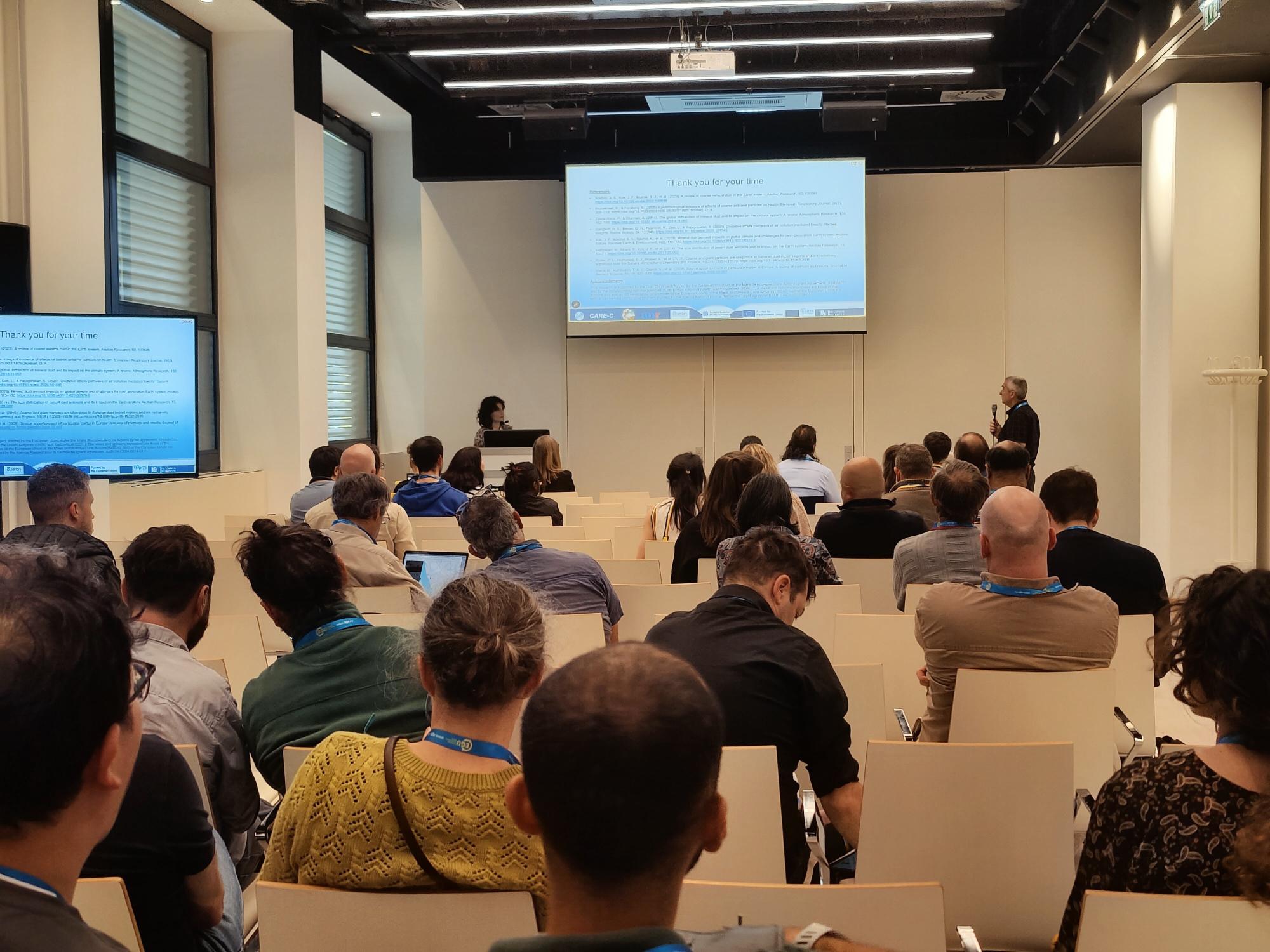
Innovation in environmental monitoring was highlighted at the EGU General Assembly 2026 in Vienna, Austria, where the ENVRINNOV project, in collaboration with the GEORGE project, organised a dedicated session bringing together experts from across the ENVRI community. The session included a diverse range of presentations, showcasing how emerging technologies, advanced services, and cross-domain collaboration are helping environmental research infrastructures respond to current challenges such as climate change, biodiversity loss, water scarcity, and ocean degradation.
The session, entitled “Advancing Environmental Sciences with Innovation and Research Infrastructures,” which took place on 7 May, 2026, focused on the role of emerging technologies and service-oriented approaches in addressing major environmental challenges. It highlighted how environmental Research Infrastructures (RIs) across atmospheric, marine, ecosystem, and solid earth sciences are driving innovation in environmental observation, long-term monitoring, and data stewardship.
Previously organised online as the annual Innovation Workshop in Atmospheric Measurements, this year’s iteration took place at EGU 2026 and expanded beyond atmospheric sciences to include all the ENVRI domains. This created valuable opportunities for interdisciplinary exchange and strengthened collaboration across the ENVRI ecosystem, one of the main aims of the ENVRINNOV project.
The session featured 10 oral presentations and 10 posters showcasing advances in advanced and autonomous sensors, unmanned aerial systems, satellite constellations, Internet of Things (IoT) networks, and Artificial Intelligence (AI)-driven approaches for environmental data processing and predictive modelling. Participants explored how these innovations can enhance interoperability, improve environmental observations, and accelerate the transformation of scientific knowledge into actionable insights for policy and society.
The session also highlighted the work of the GEORGE project, a collaboration between EMSO ERIC, EURO-ARGO ERIC, ICOS ERIC and research institutions, universities, and industry partners. GEORGE is developing innovative technologies and methodologies to improve observations of ocean carbon fluxes and carbonate chemistry in diverse marine environments, helping address critical gaps in ocean monitoring capabilities.
In addition to technological innovation, the session emphasised the importance of services provided by environmental research infrastructures, including Trans-National Access (TNA), FAIR data practices, interoperability frameworks, cloud-based infrastructures, and user-centred service design. These services play a key role in ensuring that ENVRI resources remain accessible, interoperable, and impactful for research, policy, and society.
By bringing together multiple environmental domains under a shared innovation-focused discussion, the session demonstrated ENVRINNOV’s contribution to strengthening collaboration, promoting innovation uptake, and supporting the development of a more connected and future-oriented ENVRI community.
GEORGE project received funding from European Union’s horizon Europe programme under grant agreement no.101094716
“Funded by the European Union. Views and opinions expressed are however those of the author(s) and do not necessarily reflect those of the European Union or REA. Neither the European Union, nor the granting authority can be held responsible for them.”