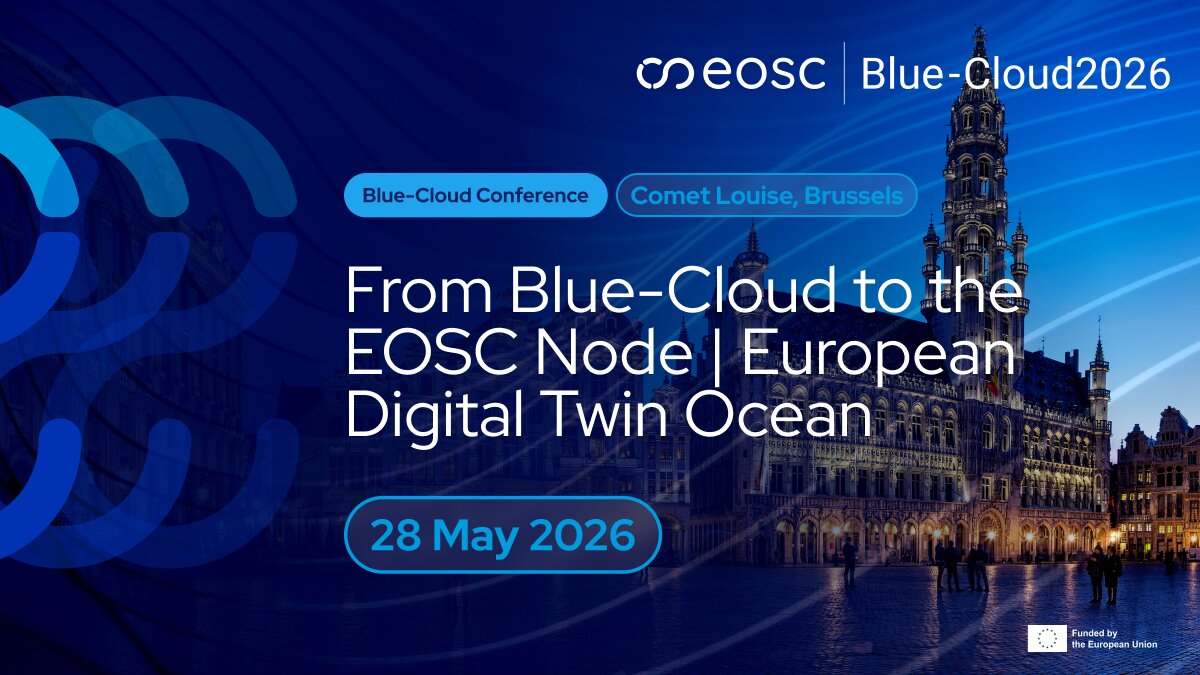
From Blue-Cloud to the EOSC Node | European Digital Twin Ocean – Blue-Cloud 2026 Conference

28 May 2026 | Brussels, Belgium

Europe’s ambition to restore and protect its oceans and waters relies increasingly on open, interoperable, and trusted digital infrastructures capable of transforming data into actionable knowledge.

Over the past years, Blue-Cloud has played a foundational role in federating marine and environmental data, services, and analytical tools across Europe. Through close alignment with the European Open Science Cloud (EOSC), Blue-Cloud has demonstrated how cloud-based, open science environments can support ocean research, innovation, and policy making.

This work directly contributes to the objectives of the EU Mission: Restore our Ocean and Waters, the EU Digital Twin of the Ocean (including EDITO, its core public infrastructure), and the UN Ocean Decade, by enabling data-driven solutions for ocean sustainability.

As Blue-Cloud 2026 reaches its conclusion, the project hands over a mature, policy-aligned digital legacy: the EOSC Node | European Digital Twin Ocean, is progressing towards operational integration within the EOSC Federation.

Participants will leave with first-hand experience of the EOSC Node European Digital Twin Ocean, insights into Blue-Cloud’s legacy, and a clear view of Europe’s path toward a federated, policy-aligned digital ocean ecosystem, aligned with the goals of EU Mission: Restore our Ocean and Waters, the EDITO, and the UN Ocean Decade.

ENVRI-Hub NEXT at the event

Tjerk Krijger (MARIS B.V. / SeaDataNet) is presenting the ENVRI-Hub NEXT poster “Enabling access to ECV-related observation datasets from environmental Research Infrastructures” during the event.

ENVRI-Hub NEXT at the 2026 GEO Symposium

The 2026 GEO Symposium and GEO-21 Plenary are held in Geneva, Switzerland, from 26 to 28 May 2026.

Held under the theme “Investing in Earth Intelligence for a Resilient Future,” the 2026 GEO Symposium and GEO-21 Plenary will convene governments, space agencies, research organizations, private sector innovators, and development partners to explore how Earth Intelligence can drive transformative, resilient solutions for people and the planet at a pivotal moment in the implementation of GEO’s Post-2025 Strategy.

Location: World Meteorological Organization (WMO), 7bis, avenue de la Paix, 211 Geneva 2 – Switzerland

Community Event – GEO In-situ Data Strategy and Its Implementation Plan (ODOK Session)

26 May 26, 11:45 – 13:00 | Salle C1

This session aims to advance understanding and alignment around the GEO in situ data strategy and its endorsement by bringing together key initiatives, user needs, and practical applications of in situ data. It will highlight the role of research infrastructures as custodians of high-quality in situ observations, present mechanisms, for articulating user requirements, and showcase integrated approaches combining Earth observation, citizen science, and non-space data sources for environmental compliance and decision-making.

The session will also introduce the GEO in situ data strategy, inviting feedback and discussion to support its refinement, community buy-in, and formal endorsement.

Presentations

  • ENVRI-Hub Next: A FAIR entry point to Essential Climate Variables – Alessandro Turco (EPOS ERIC, ENVRI-Hub NEXT)
  • GEO and Research Infrastructures as Custodians of In-situ Data – Emmanuel Salmon (ICOS ERIC)
  • G-REQs: The way you can tell us what in-situ data you need  – Alba Brobia (CREAF)
  • Earth Intelligence for Environmental Compliance: Integrating Earth observation and citizen science through ENFORCE – Francesca Piatto (EARSC)
  • From Innovative Non-space Earth Observation to Resilient Decisions: Climate, hazards, and water-land services – Eleni Athanasopoulou (NOA)
  • GEO In-situ Data Strategy (In-situ Data Co-chairs: Helen Glaves, Joan Masó, Leo Chiloane)

The Upgraded ENVRI-Hub Launches for the Environmental Research Community

A new chapter begins for integrated environmental science with the public launch of the upgraded ENVRI-Hub. Developed over two years by the ENVRI-Hub NEXT project, this platform is now available to the research community, offering improved access to Europe’s environmental research infrastructures.

“This launch is a testament to the consolidated collaboration across our consortium of Research Infrastructures and e-infrastructures, which has also been showcased on major stages like the EGU General Assembly and meetings with international communities such as WMO.” Marta Gutierrez, EGI Foundation, ENVRI-Hub NEXT Project Director

Your Gateway to Environmental Research

The launch is built upon the solid foundation laid during the project’s first 18 months, transitioning from a promising blueprint to a powerful, operational reality. The upgraded platform, accessible via its refreshed landing page, integrates a suite of enhanced and new tools designed for researchers:

  • A Catalogue of Services  and Catalogue of Data: Serving as FAIR-compliant entry points, the Catalogues offer intuitive interfaces and API access libraries, streamlining the discovery of data and services across Europe’s research infrastructures.
  • The new ENVRI Knowledge Base transforms how you find information. Powered by advanced AI, it enables dialogue-based natural-language searches to quickly locate datasets, publications, and code across the environmental sciences.
  • An Analytical Framework supported by two harmonised Python libraries, allowing programmatic access to the Catalogue of Services and to the environmental research infrastructure’s datasets. 
  • A global design focussing on essential climate variables (ECVs) with new filtering options in the Catalogue of Services, specific indexation in the AI system, specific parameterisation possibilities in the Python libraries, and normalised by the iADOPT ontology to describe scientific variables in a common way.  
  • Single Sign On across the Hub services and integrated research infrastructures through ENVRI-ID, an EOSC-interoperable Authentication and Authorization Infrastructure (AAI), via a range of providers such as EDUGAIN, ORCID, Google and GITHUB.
  • In collaboration with our sister project ENVRINNOV, we have integrated an Innovation Hub. This new component connects scientific research with entrepreneurial vision, fostering the development of market-ready solutions and sustainable business models from environmental data.

“The 2026 deployment successfully integrates our core services, from the Catalogue and Knowledge Base to the Analytical Framework, into a cohesive platform. This technical milestone proves our architecture is robust and ready for community testing and validation. Beyond technical readiness, this also represents the foundational milestone in establishing the ENVRI-Hub as the definitive ENVRI Node within the EOSC Framework, bridging the gap between environmental science and EOSC.” Ulrich Bundke, Forschungszentrum Jülich & IAGOS, ENVRI-Hub NEXT Technical Coordinator

Contribute to the Launch

This new Hub is built for and with our community. We invite all researchers, data scientists, and stakeholders to explore its capabilities, test its features, and shape its future.

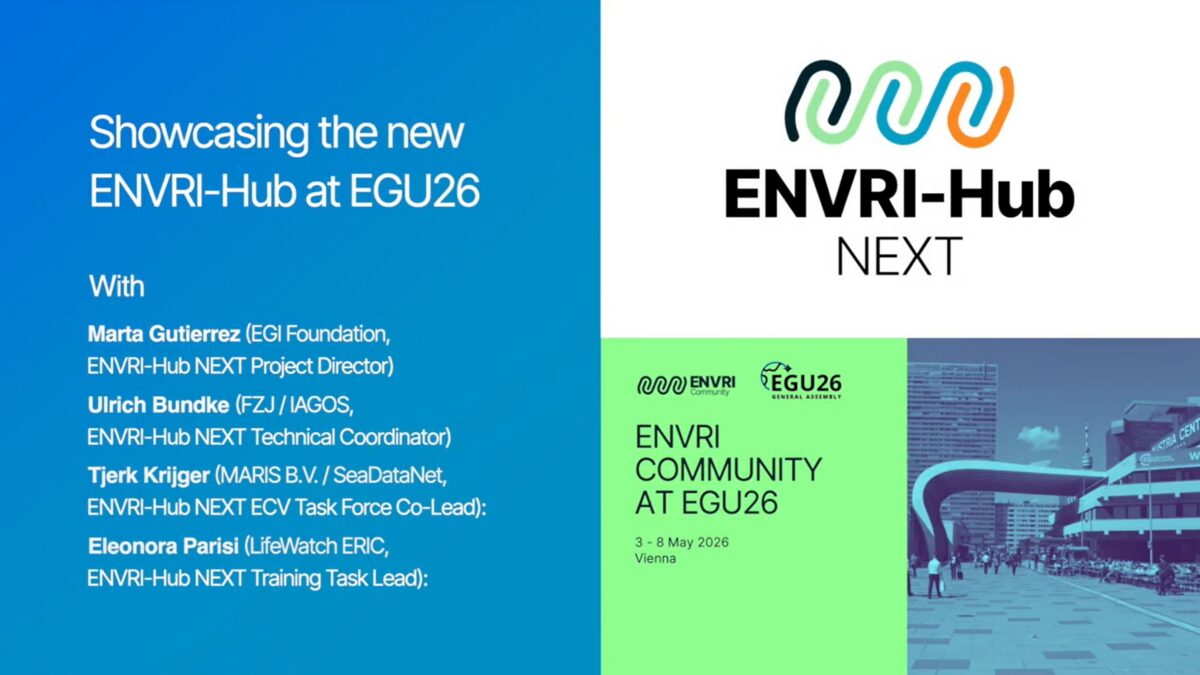
To introduce the platform, we have hosted a dedicated launch webinar on 23 April 2026, providing an overview and quick demonstrations of some of the Hub’s new features. Meet us at EGU26 in Vienna and take the short course about the ENVRI-Hub.

Your exploration and feedback are crucial as we enter this exciting final year of the ENVRI-Hub NEXT project, focusing on community-driven refinement and widespread adoption. You can sign up for the ENVRI-Hub User Group to receive updates about meetings, consultations, training activities, and contribute to the future evolution of the Hub.

ENVRI-Hub Featured in ERCIM News Special Issue on Open Science

An article about the ENVRI-Hub was published in the April 2026 issue of ERCIM News on Open Science Experiences and Prospects

An article introducing the ENVRI-Hub was published in the April 2026 edition of ERCIM News (Issue 144), as part of the special theme “Open Science Experiences and Prospects”.

The article, titled “ENVRI-Hub: A Science Gateway for Open Environmental Research,” was authored by Federico Drago (EGI Foundation), Delphine Dobler (Euro-Argo ERIC), and Ulrich Bundke (Forschungszentrum Jülich / IAGOS AISBL) on behalf of the ENVRI-Hub NEXT project. It presents the recently upgraded ENVRI-Hub platform as a central science gateway for Europe’s environmental research, demonstrating how interoperable Virtual Research Environments can accelerate collaborative Open Science and make FAIR data actionable for tackling global challenges.

About the Special Issue

Guest edited by Leonardo Candela (CNR-ISTI) and Roberto Di Cosmo (Inria and University Paris Cité), the special theme explores the current state of Open Science across Europe. The editors note that while Open Science has become an operational requirement embedded in national strategies and funding conditions, fragmentation remains a key challenge. The issue brings together contributions on federated infrastructures, semantic frameworks, governance, skills, and operational experiences from major European initiatives.

The ENVRI-Hub article sits within a cluster of contributions focusing on operational experiences with federated science gateways, alongside pieces on the EOSC EU Node, the EOSC Core Innovation Sandbox, D4Science virtual research environments, and other initiatives.

About the Article

Our contribution describes how the ENVRI-Hub enables researchers to search for, access, and process datasets and services across Europe’s environmental research infrastructures. It highlights key components such as the Catalogue of Services, the AI-powered Knowledge Base, and the Virtual Research Environment interface, with a core focus on making Essential Climate Variables (ECVs) easily accessible and processable from all contributing sources. The article also emphasises the platform’s community-driven development and its alignment with the European Open Science Cloud (EOSC).

The full ERCIM News Issue 144 is available online.

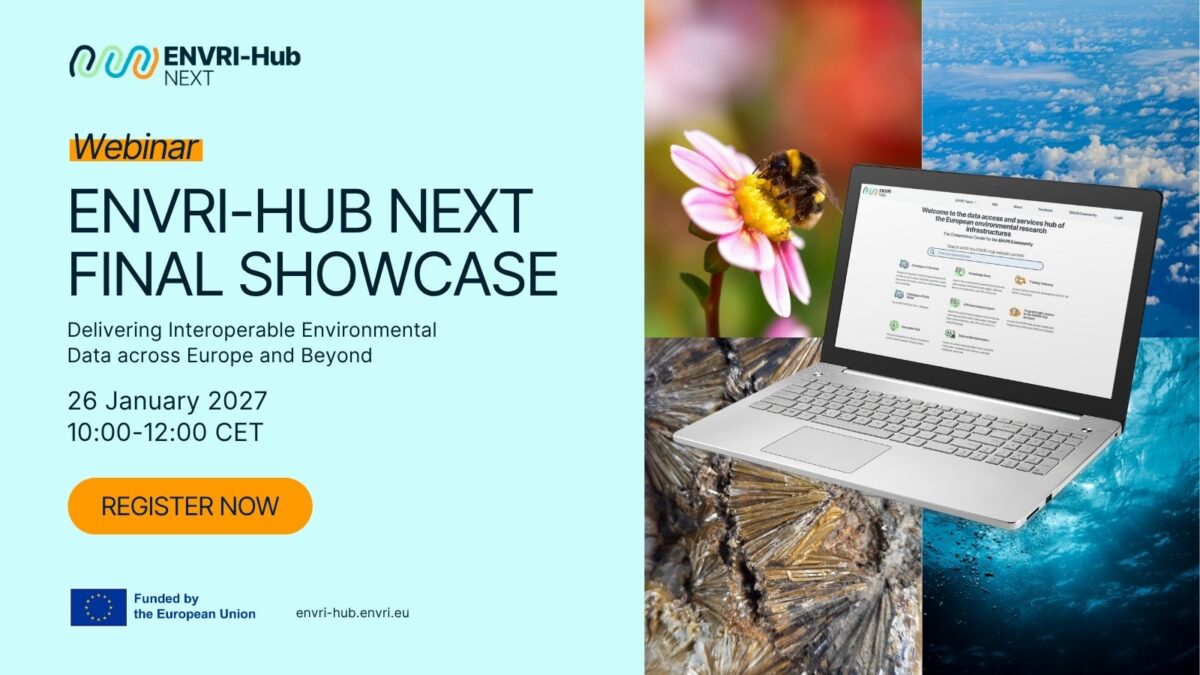
Webinar: Introducing the New ENVRI-Hub for Environmental Research

23 April 2026 – 11:00-12:00 CEST

Join us for the official launch webinar of the upgraded ENVRI-Hub! Over the past two years, the ENVRI-Hub NEXT project has reimagined and rebuilt the central platform for Europe’s environmental research infrastructures (RIs).

In this 60-minute session, we have:

  • Provided a brief overview of the ENVRI-Hub NEXT project and its goals.
  • Introduced the major changes and new architecture of the ENVRI-Hub.
  • Offered live demonstrations of two core new features:
    • The enhanced Catalogue of Services: Discover and access FAIR data and services more intuitively than ever.
    • The intelligent ENVRI Knowledge Base: See how AI-powered, dialogue-based search helps you quickly find datasets, publications, and analytical code.

This webinar is essential for researchers, data scientists, and anyone who relies on integrated environmental data. See firsthand how the new ENVRI-Hub can streamline your workflow and empower your science.

Agenda and Slides

EOSC Symposium 2026

The EOSC Symposium 2026 will take place from 14 to 16 October in Florence, Italy. As the EOSC flagship event, the Symposium annually brings together the entire stakeholder community, including researchers, policy-makers,  organisations and infrastructures to share and celebrate the latest developments around EOSC and the EOSC Federation. Be sure to save the dates in your calendar. Further details coming soon!

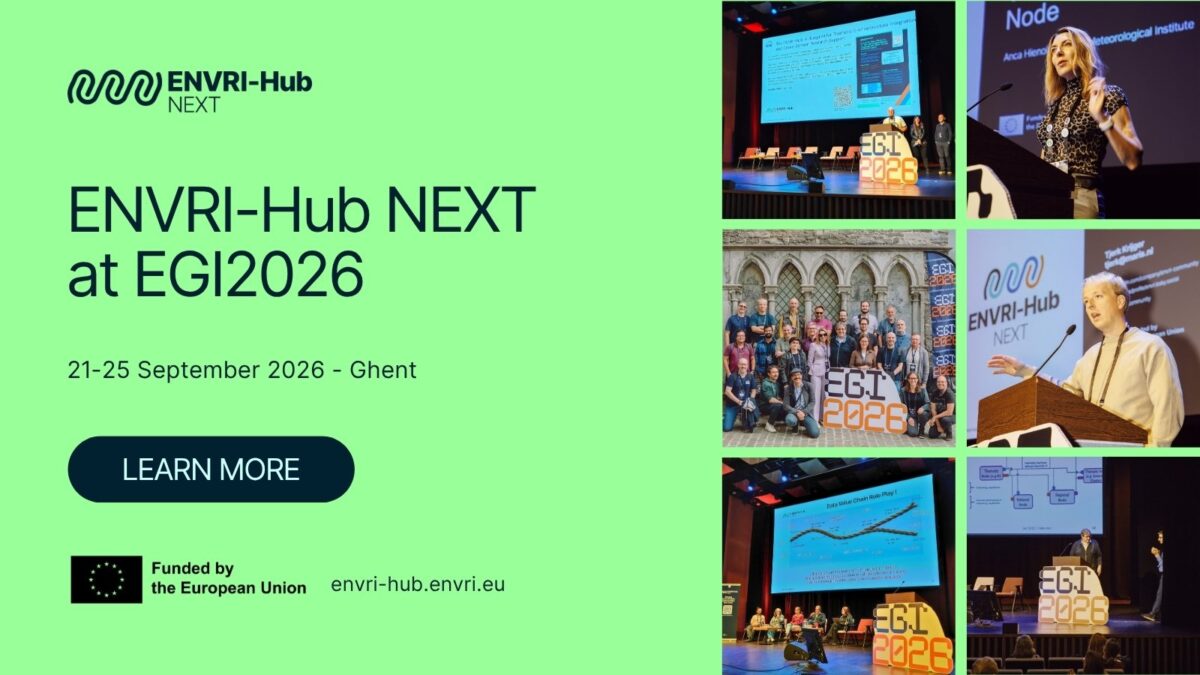
ENVRI at EGI2026

The EGI2026 Call for Contributions is open!

Every year, the EGI conference brings together scientists, service providers, technical experts, policy makers, and early-career researchers to present their work, join workshops and trainings, participate in project meetings, and overall to experience the pleasure of meeting each other in person (again). By submitting your proposal for a talk, poster, or demonstration, you get the chance to be part of the programme!

This year, the conference brings us to lovely Ghent, where it will take over the historic 13th-century ‘Bijloke’ venue for an engaging and full conference programme.

The EGI Foundation is the coordinator of the ENVRI-Hub NEXT project.

Deadlines

Call Open: February 24 2026
Deadline: April 13 2026, 23:59 CET

Confirmation of acceptance: On or before April 30. 

Useful Links:

Call for Partners

If you are interested in joining us this year, please consult our Partner Brochure for more details and pricing, and don’t hesitate to reach out have any questions or special requests. 

ENVRI-Hub NEXT Contributes Expertise to WMO iClimateAction Initiative

In the photo, left to right: Cathrine Lund Myhre (ACTRIS), Marta Gutierrez (EGI Foundation), Alex Vermeulen (ICOS), Anca Hienola (Finnish Meteorological Institute), Paolo Laj (WMO). Photo courtesy of WMO and iClimateAction. 

Over the past several months, ENVRI-Hub NEXT representatives have played an active role in shaping discussions within the WMO’s iClimateAction (iCA) initiative, contributing key expertise on Essential Climate Variables (ECVs) and technical developments from the ENVRI-Hub platform.

The engagement began in the autumn of 2025 with a series of technical webinars designed to prepare participants for an in-person joint meeting of the GCOS-WGClimate-iClimateAction, hosted at ESA in Harwell, UK, from 9 to 13 February 2026. These sessions aimed to give participants a shared understanding of the current landscape of climate data and knowledge systems, enabling focused discussions on gaps, priorities, and next steps.

“Essential Climate Variables (ECVs) are critical to understanding global climate impacts. The climate observation data value chain is a complex ecosystem currently undergoing rapid evolution driven by the AI revolution. ENVRI-Hub NEXT will support the iClimateAction activity by facilitating the assessment and exploitation of the diverse climate observing systems the ENVRI community offers.” – Marta Gutierrez, EGI Foundation, ENVRI-Hub NEXT Project Director

ENVRI-Hub NEXT Webinar: Harmonising Access to ECV Observations

On 15 January 2026, ENVRI-Hub NEXT presented its work during the second iClimateAction webinar. Marta Gutierrez (EGI Foundation) introduced the ENVRI community and the ENVRI-Hub NEXT project, with technical contributions from Anca Hienola (Finnish Meteorological Institute) and Ulrich Bundke (Forschungszentrum Jülich).

The presentation highlighted how ENVRI brings together Europe’s major environmental research infrastructures, collecting ground-based observations across the atmosphere, land, oceans, and ecosystems. These observations play a critical role in the climate data value chain. However, a persistent challenge is that high-quality data often remains difficult to find and use together due to differing formats, access protocols, and terminologies across infrastructures.

ENVRI-Hub NEXT addresses this by providing a common access layer that connects these distributed infrastructures without centralising their data. A key focus is on Essential Climate Variables (ECVs): scientists from different research infrastructures work together to map their existing measurements to the ECVs defined by GCOS, ensuring that data from diverse sources can be compared and combined reliably.

The discussion also emphasised usability. For many users, downloading entire datasets is neither practical nor necessary. ENVRI-Hub NEXT is therefore developing targeted access capabilities, allowing researchers to extract precisely the data they need—by location, time period, or variable—and use it directly within their analysis tools, without needing to master each infrastructure’s system in detail.

Bringing ENVRI Perspectives to the Harwell Meeting

Building on this webinar, Marta Gutierrez, Anca Hienola, Alex Vermeulen (ICOS) and Cathrine Lund Myhre (ACTRIS) represented the ENVRI-Hub NEXT consortium at the in-person GCOS-WGClimate-iClimateAction Joint Meeting in Harwell, UK (9–13 February 2026). There, they shared perspectives from the ENVRI community, contributing to discussions aimed at strengthening the technical basis for future climate reporting, planning, and coordination under the next phase of iClimateAction.

The meeting brought together specialists in climate observations, data, and knowledge systems from GCOS, WMO, GEO, and partner organisations, working collectively to support the delivery of the new GCOS Status Report.The ENVRI community contributed with the expertise and key contributions from the in-situ networks they operate and the ECVs that they have to offer.

This engagement underscores ENVRI-Hub NEXT’s commitment to advancing global interoperability for climate research, ensuring that Europe’s environmental research infrastructures are not only connected but actively contributing to international frameworks and policy needs.

Learn more about iClimateAction: https://wmo.int/iclimateaction

EVERSE Community Engagement Event

Date: 5 February 2026
Location: CERN, Geneva, Switzerland

The EVERSE Network of Research Sofware Quality is a community community that will improve the quality of research software in Europe.

The EVERSE project created a set of guidelines and resources into the RSQkit (Research Software Quality Kit) and the Technology Radar to share existing best practices and ideas.

This event seeks to bring together EVERSE members with  RSEs and researchers who code, to share updates on EVERSE activities, foster knowledge-sharing and cross-domain collaboration, gather feedback and identify priorities.

Whether you are a researcher or RSE, whether you are involved in European Open Science clusters, or undertaking a similar role in academia, labs and industry, this is your chance to learn about these initiatives, and gives us your perspectives.

Thierry Carval (IFREMER & Euro-Argo ERIC) takes part in the session “Science Clusters: Cross-domain experiences and challenges” at 11:00 CET.

ENVRI-Hub NEXT at ISGC 2026

Date: 15-20 March 2026
Location: Taipei

The exponential growth of research data is reshaping the scientific landscape. What once came mainly from controlled experiments is now complemented by continuous streams from sensors, simulations, and digital interactions. A central focus is the need for trustworthy and sovereign data ecosystems that allow researchers to retain control over sensitive resources while enabling collaboration across disciplines and borders. At the same time, the rise of AI-driven discovery and decision-making places new demands on data quality: models require information that is not only accurate but also transparent in origin, rights, and conditions of use.

ISGC 2026 focused on the theme “Trustworthy Infrastructures and AI for Global Open Science – Enabling Data Sovereignty and Secure Research Collaboration”, addressing pressing issues such as Artificial Intelligence (AI), Security, Data Sovereignty, Open Science, Research Infrastructures, Ethics of Computing, Societal Impacts, Misinformation and Disinformation, Sovereign Capabilities, Global Collaborations, and Science for a Sustainable Future. Bringing together leading experts from academia, research infrastructures, and industry, ISGC 2026 explores how emerging technologies—from AI and quantum-enhanced computing to big data analytics—can shape a trustworthy and sustainable future across disciplines.

The program spans 10 scientific topics: Physics & Engineering Applications, Health & Life Sciences, Earth & Environmental Sciences & Biodiversity, Social Sciences & Humanities, Virtual Research Environments, FAIR & Trusted Data, Networks & Security Infrastructures, Cloud & Virtualization, Converging High-Performance Computing, and Artificial Intelligence (AI). Through keynotes, workshops, international project reports, and peer-reviewed contributions, ISGC 2026 continues to strengthen global collaborations, cultivate future scientific leaders, and bridge cutting-edge technologies with societal responsibility.

ENVRI-Hub NEXT at ISGC 2026

Zhiming Zhao, University of Amsterdam and part of the ENVRI-Hub NEXT project, presented the poster “Enhancing Virtual Research Environments for Environmental Research Using Advanced AI” in the poster session.