

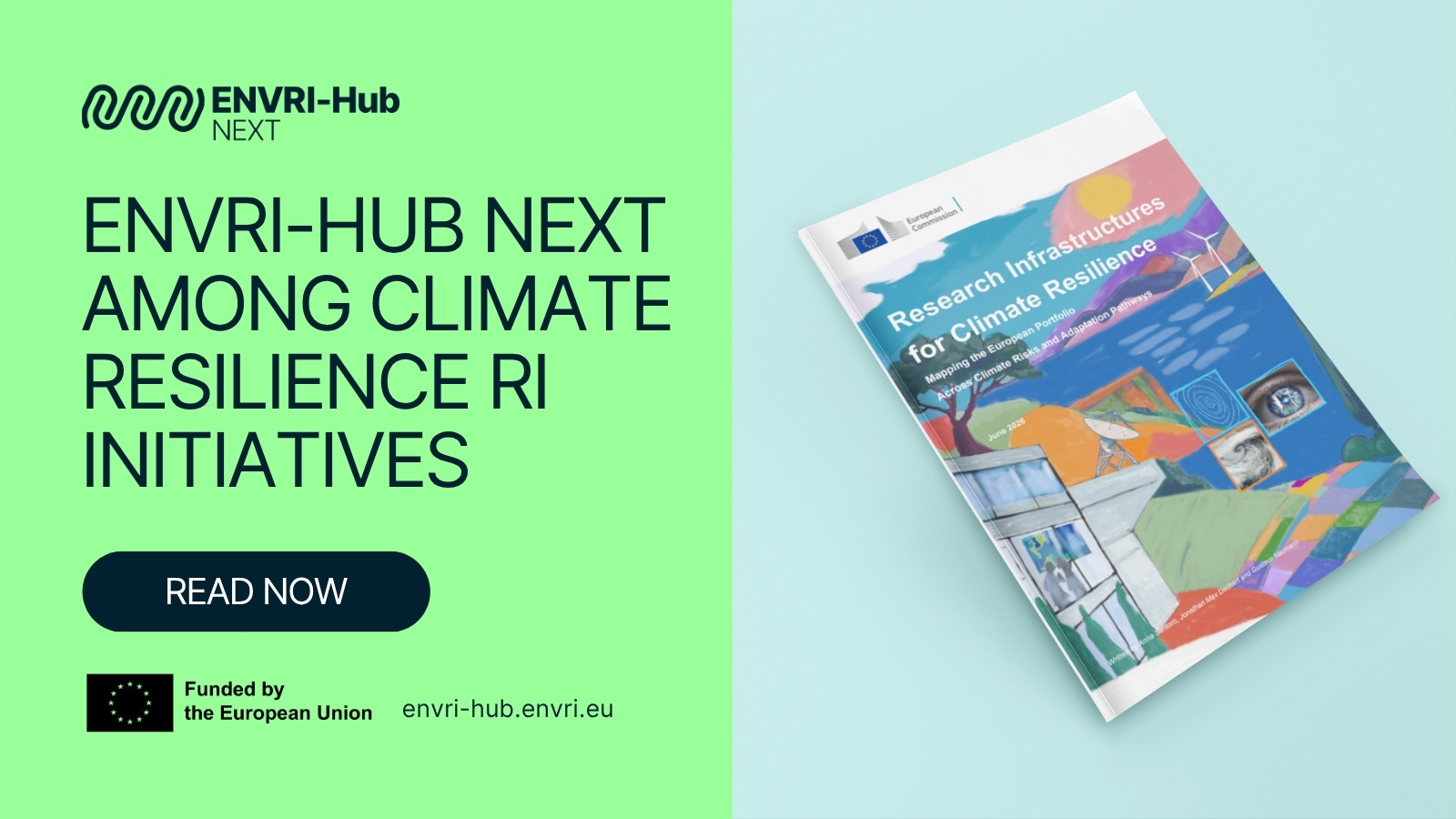
A new European portfolio analysis recognises ENVRI-Hub NEXT among the cross-cutting initiatives helping to connect research infrastructures, data and modelling capabilities across multiple climate-risk domains.
The report, Research Infrastructures for Climate Resilience: Mapping the European portfolio across climate risks and adaptation pathways, examines 38 projects representing more than €300 million in EU funding. It explores how Europe’s investment in research infrastructures contributes to climate resilience priorities and identifies opportunities for future EU Framework Programmes.
The analysis finds that Europe has developed a mature and highly interconnected research infrastructure landscape, broadly aligned with the priorities of the European Climate Risk Assessment (EUCRA). Environmental research infrastructures, supported by increasingly advanced digital services and modelling platforms, provide a strong scientific foundation for climate resilience policy and risk management.
“Europe’s climate resilience depends on how effectively we connect what we observe to how we act. ENVRI-Hub NEXT provides that crucial bridge, uniting environmental Research Infrastructures data across domains to deliver actionable insights where it matters most.“ Marta Gutierrez, ENVRI-Hub NEXT Project Director (EGI Foundation)
Bridging Environmental Observations Across Domains
The report places ENVRI-Hub NEXT within the Ecosystems risk cluster, which dominates the climate resilience RI portfolio with €99 million across 12 projects. This cluster aligns with EUCRA’s “More Action Needed” urgency score, confirming that Europe possesses a world-class, well-resourced scientific foundation for monitoring biodiversity loss, ecosystem degradation, ocean change and atmospheric processes.
The report specifically highlights how ENVRI-Hub NEXT builds common services across major infrastructures such as ACTRIS, ICOS, Euro-Argo, EPOS, IAGOS, eLTER, LifeWatch ERIC, and AnaEE-ERIC. Through shared metadata standards, interoperable catalogues, virtual research environments and integrated access services, the project enables researchers to combine observations from multiple Earth-system domains. This is particularly relevant for climate resilience challenges, where understanding interactions between the atmosphere, oceans, ecosystems and human activities requires integrated rather than sectoral approaches.
The report also notes that ENVRI-Hub NEXT advances the implementation of FAIR data principles, facilitating access to environmental data and increasing its usability for researchers, policymakers and other stakeholders. This aligns closely with the project’s mission to provide a unified gateway to Europe’s environmental research infrastructures, making Essential Variables, a set of variables that allows scientists, scientists and policymakers to monitor the health of our changing planet, discoverable and processable across all contributing sources.
“The document underscores what we have been building: a technical framework that allows researchers to move seamlessly across infrastructures. Our work on shared metadata, interoperable catalogues, and integrated access services is now being recognised as a critical component of Europe’s climate resilience infrastructure.” Ulrich Bundke, ENVRI-Hub NEXT Technical Coordinator (Forschungszentrum Jülich / IAGOS)
The Path from Data to Climate Action
The report recommends further investment in integrated research infrastructure ecosystems, wider access to facilities and services, and stronger pathways for turning scientific knowledge into decision-ready climate intelligence. These priorities are central to ENVRI-Hub NEXT’s work.
By connecting environmental observations, data resources and analytical capabilities, ENVRI-Hub NEXT supports research that can contribute to more effective climate adaptation, preparedness and risk management. The report provides valuable independent recognition of the role that connected and accessible research infrastructures can play in building a more climate-resilient Europe.